
Thoughts on Kintsugi, Healing, and God's Redemptive Processes
Spoiler: It's messier (for us) than we might like

I've been thinking about kintsugi. For a while, actually. I first drafted this post in my notes app on my phone late at night on Feb 10th, but I didn’t feel qualified to post it. I hardly have expertise in kintsugi, healing, mental health, or theology. Honestly, I still don’t feel qualified, but I keep randomly thinking about this topic and about posting this, so maybe that’s a divine nudge to post my imperfect, inexpert words, and maybe God can use them to bless someone.
Anyway, for a while, Instagram was showing me pottery videos, which was fun. Then IG started showing me kintsugi videos.
Caveat first of all that I'm not a kintsugi expert. I've seen just enough videos and done just enough Googling to have enough knowledge to have philosophical and theological musings and a shaky grasp on the process.
If you don't know, kintsugi is an ancient Japanese art of fixing broken porcelain and instead of trying to disguise the cracks, they're done in gold, often making the restored porcelain more beautiful and certainly more unique than before.
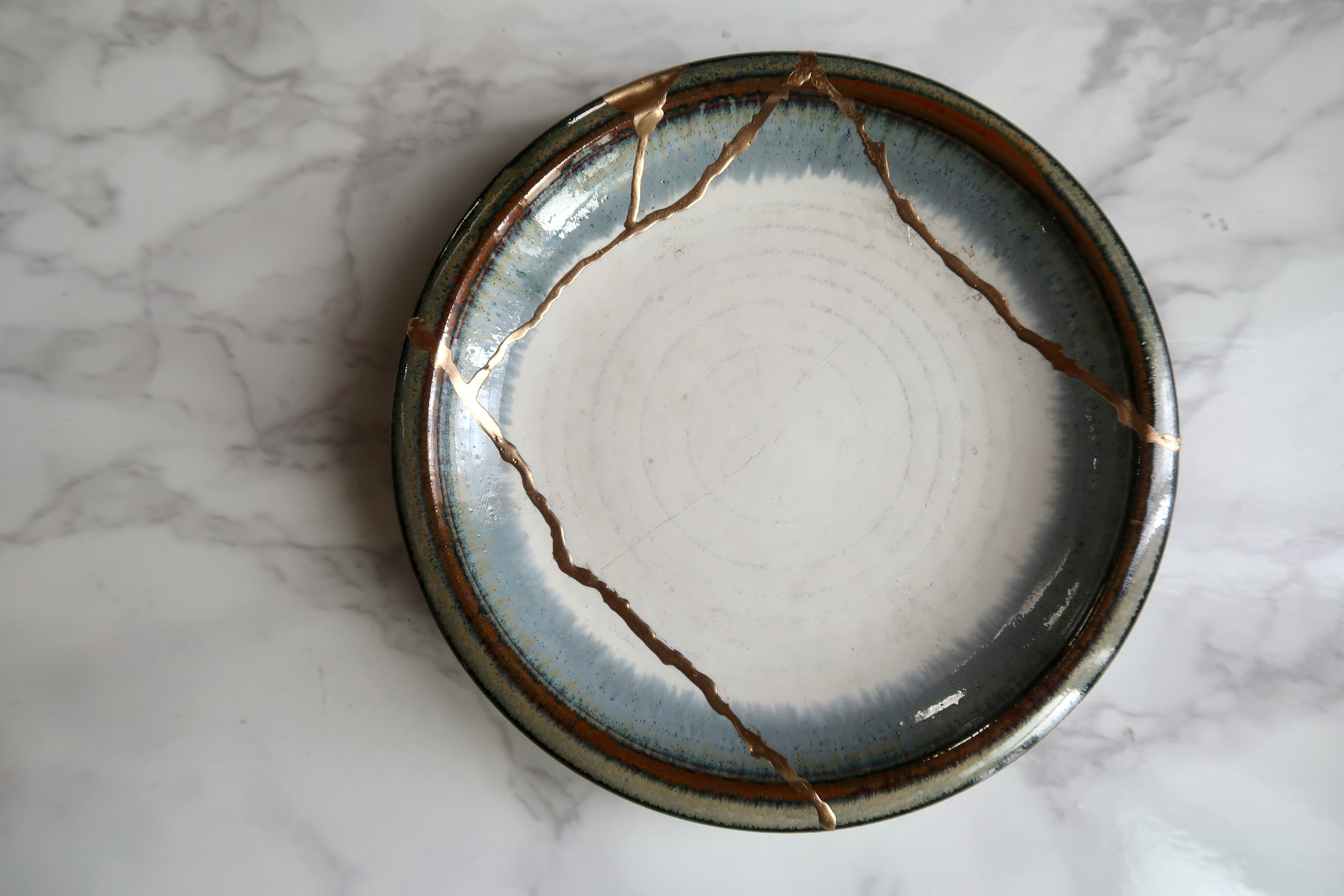
Kintsugi seems to be a fairly common illustration in Christian circles of healing and God's redemptive work in turning what was meant for evil into good. Taking something, or someone, broken and hurt by wickedness or the “not-good-ness” of this world that is groaning under the weight of sin and making it new. In redemption and healing, like kintsugi, the scars don't disappear, the brokenness and hurt is not ignored or claimed to be not a big deal, but the vessel is given new life, new purpose, new beauty. Arguably, it’s more beautiful and valuable now, because of both the gold and the value demonstrated by restoring rather than discarding.
It's a beautiful illustration. Sometimes speakers or artists etc. who use this illustration will even mention that kintsugi is a time-consuming art that involves a lot of care and attention.
But, much like how the church often talks about God's healing and restorative work, this is an overly simplistic and rosy view of kintsugi.
The act of breaking, the reason kintsugi is needed, is violent and not itself good. That's usually acknowledged, and part of the beauty is taking what was decidedly not good and restoring and redeeming it.
But traditional kintsugi itself can be painful, if you're the object it's being done to.
See, I learned some startling things from those kintsugi videos on Instagram. One of which is a reminder that my patience and attention span is poor, as one time I fast forwarded through a video that condensed weeks of real time into like, three minutes. 😅
More importantly, I learned:
1) Kintsugi is a multi-step process. The way some people have explained kintsugi, as I did above, makes it sound like it's literally fusing the pieces together with molten gold (sometimes I even see kintsugi described as "fixing pottery with gold").
It's not.
There seems to be various methods and slight variations in materials and steps that can take more or less time, but here is the approximate basics of traditional kintsugi. (For this, I’m ignoring modern faux-kintsugi, such as superglue covered in gold paint, which doesn’t produce something that is food-safe.)
First, the pieces get bound back together in an very ugly way, with a glue called mugi-urushi ("wheat lacquer") that is made by combing flour, water, and lacquer. The mugi-urushi is not pretty—it's a brown or black color, and until it sets, the piece has to be held together with tape or string. The mugi-urushi takes about a week to set—maybe more depending on thickness. Once dry, the tape/string gets removed, and any extra lacquer has to be scraped off. Next, sabi-urushi is made by mixing lacquer, water, and tonoko, a clay powder. Sabi-urushi is painted and rubbed over the lines and used to fill any chips or crevices. It takes at least a couple days to dry. The brown sabi-urushi then gets sanded down. Then, lacquer is mixed with red paint and slowly and meticulously painted over the lines. This red color clashes with most porcelain designs and takes at least another day in a warm and humid environment to dry. That gets smoothed down with charcoal. A black roiro lacquer gets painted over that and dries for another day and again filed down with charcoal. Do we get gold now? No. Another red lacquer (which may need strained for smoothness) gets painstakingly painted on. (It is slightly surprising to me that I have never seen anyone point out the visual symbolism afforded by “by his wounds we are healed” and the presence of red lacquer in the kintsugi process.) That usually has to partly dry so it's tacky/sticky. Now gold luster dust gets brushed onto that, then polished with silk, and might be sealed as well (which also has to dry). That's a lot of steps. A lot of waiting. A lot of possibly seeming abandoned during the process because the timing isn't right yet for the next step.
2) Kintsugi can appear destructive. Edges may need sanded down before they can be pasted back together with the mugi-urushi. Pieces are put together in sections. The string holding the piece together until dry has to be fairly tight.
If there are large sections missing or that broke too badly to be salvaged, a new piece had to be made and put in place. The new pieces won't feel familiar. I've seen videos where the restorer DRILLED tiny holes into the surrounding pieces and inserted thin wires into those holes to help the new clay keep its shape and strength. With this method, it's possible the object as a whole might need re-fired. And the new clay piece will look ugly until it reaches a point where it can be painted to match the rest of the object—in-between the sabi-urushi and the roiro lacquer, most likely.
I imagine the ceramic object being repaired might feel like things are getting worse. I can imagine the object questioning if the restorer actually has its good in mind. I can imagine it feeling like the healing process has backslid as it faces new fires and new hurts. Enduring the discomfort of being forced back into shape after being shattered, then being rubbed and sanded right over the same cracks, only to seemingly be left alone again.
I think kintsugi is a great illustration of healing and God's redemptive work in our lives, but not only as evidence of His care and the beauty when we finally get to the end. It's also a good illustration of how difficult healing can be. Of how redemption and restoration can take time and feel messy. Of how God's timing and vision might not make sense to us during the process.
I don't have super practical answers on what this means for you, and I'm certainly not saying your current hurts are all a result of God's restorative work in your life. The world is broken and sinful. Shattering, breaking, and hurts happen (and they break God’s heart).
But if you've thought, "I felt like God was restoring me, was redeeming the hurt, but now I'm hurting again in the same places, or I feel like I haven't seen God working in the same way He was for a while," take heart—that doesn't mean the restorative, redemptive work has been abandoned. You don't have to pretend you aren't hurting to believe that God is still working. It takes time, and the work itself may sometimes hurt, but you can be confident that the Restorer does, in fact, have good plans for and good thoughts toward you. He does see you and knows what you're going through. He does care and does have a plan that leads from ashes to beauty.
He has made everything beautiful in its time. -Ecclesiastes 3:11a
For I know the plans [thoughts] I have for you, declares the LORD, plans for welfare and not for evil, to give you a future and a hope. -Jeremiah 29:11
And after you have suffered a little while, the God of all grace, who has called you to his eternal glory in Christ, will himself restore, confirm, strengthen, and establish you. - 1 Peter 5:10
He heals the brokenhearted
and binds up their wounds. -Psalm 147:3
But God, being rich in mercy, because of the great love with which he loved us, even when we were dead in our trespasses, made us alive together with Christ—by grace you have been saved— -Ephesians 2:4-5
I read this on my phone where I was not signed in to comment but it's stuck with me ever since so I had to dig back through my inbox to come say thank you for this beautiful post. <3
💙😭💙